“If you listen to anyone speak today, make sure you hear what George Gilder has to say about [this].” – Steve Forbes
The Next Big Thing

After 20 Years, a Texas Scientist Has Unlocked the Key to a 21st-Century Wonder Material That Will Ignite the Next Wave of Human Innovation
See Why “Technology Prophet” George Gilder Is Making His Biggest Investment Ever … and How You Can Join Him

Hi, I’m Roger Michalski. I’ve been the publisher at Eagle Financial Publications for the past 20 years, and today you get to witness one of the most important events in our firm’s history.
We’re joined by legendary technology prophet George Gilder to discuss what George calls “the next big thing…”
A breakthrough two decades in the making will impact every industry on the planet, power the next 50 years of human innovation, and breathe new life into age-old businesses, ushering in a new wave of corporate prosperity.

A bold claim, I realize. But when it comes to breakthrough technologies, George, more than any other man on the planet, has proven his uncanny ability to predict these landmark events before they happen.
All the way back in 1994, George forecast the invention of the iPhone, more than 10 years before its release. He did the same thing with Netflix. He even became the most-quoted living author by Ronald Reagan after tipping the president off to the rise of the silicon microchip in the ’80s.
But the subject of today’s talk is bigger than all of that. George says we are witnessing a breakthrough that rivals the invention of the microchip itself.

We’re also joined by George’s longtime colleague John Schroeter. John is a serial entrepreneur, an award-winning author, and a microchip expert with more than a dozen patents in the field.
Gentlemen, thanks for joining me – and welcome to our family here at Eagle Financial Publications. It’s a privilege to have you on board.
And that was just the last year. Thank you, Roger, for the generous introduction.
Yes, thank you. We’ve been looking forward to this a lot.
So before we get started, I want to start by saying that George and I were recently at the New York MoneyShow for accredited investors, where George gave a talk on the very subject of today’s presentation.

Steve Forbes was there. Steve and George go way back. In fact, Steve was George’s original publisher for the Gilder Technology Report.
When Steve took the stage, he concluded with a simple message: If you go see anyone talk during this event, you’re going to want to hear what George Gilder has to say later this afternoon.
High praise from a man like Steve Forbes. But it goes to show just how massive of a breakthrough this is.
Steve and I have been friends for a long time. He was in the front row when I gave my talk to a packed audience. Now, I’m excited to get the message out to an even wider audience for everyone reading this presentation.
As you mentioned, we are on the cusp of the greatest breakthrough since the invention of the microchip.
Silicon, of course, is the material of which every microchip is made. It’s what allows the switching of electrical currents on and off in the computer’s circuits. That’s why it’s called a semiconductor.
They’re inside everything. Your cell phone, your TV, your microwave, your car – electric or diesel – as well as computers, pacemakers, and all of today’s electronics.
These microchips are small … no bigger than a single grain of rice … and yet, they power everything.
For three-quarters of a century, we’ve been living in the Age of Silicon.
Now, we are entering a new dimension … and a new age.
What do you mean, a new dimension?
Let me explain it like this… With the microchip, we entered into something I call the microcosm. That’s because these microchips contain billions of transistors fabricated in silicon.
Now, a new wonder material is about to transport us to the next level. A new dimension of technology that will drive the next 30 years of innovation.
So this is interesting…
Back in 1994, you wrote: “The silicon juggernaut has only begun to realize its potential. … Today a silicon sliver the size of a thumbnail can hold 20 million transistors. Within less than 10 years, it will be possible to put a billion transistors on that sliver — equivalent to the central processing units of 16 Cray YMP supercomputers, costing $20 million each — for under $100.”
That was 30 years ago. Now … you’re saying it’s about to happen again.
Right.
Roger … you’ve probably heard of Moore’s Law. It’s the idea that the number of transistors in a microchip doubles every two years.
That’s how computing power has risen over a trillion-fold since the 1950s — yes, trillion with a “T” — most of it coming in the past 30 years, like George said.
And just as George predicted 30 years ago that we hadn’t seen anything yet, he’s predicting it again.
Yes. We haven’t come anywhere close to harnessing the full power of the integrated circuit, also known as the microchip. There’s going to be more innovation in the semiconductor industry over the next 30 years than the past 30.
It’s going to be massive.
I think it’s worth mentioning … the two of you met through the legendary Carver Mead, the CalTech physicist who coined Moore’s Law itself.
That’s right. I was actually working for Carver when George came out with his book The Silicon Eye. It tells the story of Carver’s vision for and creation of a new digital age. Ever since, I’ve devoured everything George has ever written. His book influenced Carver as well.
It’s pretty crazy the impact your books have had, George… Wealth and Poverty influenced Reagan’s policies in supply-side economics, The Silicon Eye inspired the guy who coined Moore’s Law, and I believe Steve Jobs even passed around your book Life After Television when they were developing the iPhone.
That’s correct. The point in all this, Roger, is that when it comes to Moore’s Law … we haven’t seen anything yet. The catalyst for all this is the breakthrough we’re here to discuss today.
You guys have got my attention. This sounds really, really big.
It is big. This breakthrough is a material more conductive than copper. At the same time, it’s stronger than steel … and more lightweight than paper. All by some hundreds and thousands of degrees.
It’s shocking to hear something like this actually exists.
It does. In fact, this material was first isolated by two professors at the UK’s Manchester University in 2004. They were experimenting with, of all things, some Scotch tape and a block of graphite … but when they measured the properties of the material they discovered, they were awestruck.
And for the next several years, the entire scientific community was as well. Hundreds of companies cropped up to exploit the scientists’ new wonder material. The professors themselves won a Nobel Prize.
So what happened?
What happened was what happens every time there is a new innovation that promises to transform mankind. It didn’t work at first.
For all the tens of thousands of papers that were published about how this new wonder material would launch a new wave of human ingenuity…
Reality finally set in when all these scientists awoke to the conclusion that there was no way to produce this material in large quantities at a price companies could afford. Unsurprisingly, the Scotch tape method didn’t scale.
So it was a huge breakthrough… The problem was there was no way to manufacture it within the existing infrastructure.
That’s right. But that’s all changed now.
George has discovered a scientist at Rice University in Houston, Texas, who has found the missing link after 20 long years.
This opportunity is so big, I know George is personally investing in the company.
It reminds me of one of the best investments I ever made.
In 2017, I invested in a private company called Luminar. It develops advanced lidar technology used in the self-driving car market.
Its founder, Austin Russell, was concerned that the existing technology wasn’t suited for cars on the road. It couldn’t see far enough. So Austin dropped out of Stanford and started his own company.
I met him at an event sponsored by Peter Thiel’s 1517 Fund. As one of the fund’s founding members, a few other investors and I took a private stake in his firm.
And we were happy we did. Eighteen months later, Austin emerged with a powerful new system that was 50 times better than anything else on the market.
This put him on the Forbes 30 Under 30 list and made Luminar the first firm in the history of the 1517 Fund to go public.
And the returns were tremendous. Put it like this: In 2017, the company raised over $30 million. By 2020, it had gone public with a multibillion valuation.
But that’s not the important thing about Luminar and Austin Russell. The point is, he’s a visionary.
And this scientist at Rice … you feel the same way about him.
So what is it about this man that makes him so special?
Jim is one of the leading experts in nanotechnology. Nanotechnology is the field of study where you learn how to manipulate atoms on an individual basis, at atomic scale, or nanoscale. We’ve now moved out of the microcosm into something I call the nanocosm.
But Jim has found a way to move even further beyond. There’s not even a word for it. You could call it the monocosm or perhaps the zerocosm. It’s so extraordinarily small, scientists haven’t coined a term for it yet.
This will allow us to place trillions, not billions, but trillions … perhaps hundreds of trillions of transistors on a single microchip.
Help me wrap my head around this.
Trillions of transistors… What does that look like? What kind of technology is that going to create?
We believe this is going to power the next 30 years of innovation.
Put it like this…
The original innovations in silicon led to the rise of the personal computer and the Internet.
Next, we moved into the Internet of Things … devices like smartphones, iPads, and full- fledged smart homes.
But now, we can go even further. Soon, we will enter the realm of smart CITIES … an Internet of EVERYTHING with endless benefits:
- Lower waste of vital resources like energy and water, improving operational efficiency and lower pollution
- The ability to contain the spread of diseases, reducing public outbreaks
- Less travel time, because smart sensors can detect traffic patterns in real time
- Better overall health … improved city planning … and stronger economies
So better, smarter, more efficient cities.
That’s right. And this goes way beyond technology, Roger. The implications for the field of medicine are just as huge.
Jim says this breakthrough will allow us to perform complex surgeries such as whole-eye transplants. Because this new material operates at such a minute scale, we’ll now be able to re-fuse the optic nerve even after it’s been severed.
This is something they’re already working on. By the same token, they’re working on re-fusing a severed spinal cord.
Very soon, we could cure paralysis, like the injury “Superman” Christopher Reeve suffered when he fell off his horse in the mid-’90s. Spinal injuries like this affect nearly 20,000 Americans per year. And 1 in 50 Americans suffers from milder forms of paralysis.
And it’s not far off. They’ve already performed this procedure on rats, restoring near-perfect motor control.
He’s not just a brilliant scientist. He is doing God’s work. Making the lame walk, the blind see, and the deaf hear. His team has already cured a man’s deafness.
This is why Jim was recently chosen for a list as one of the world’s 50 most important scientists.
Sort of like how Austin Russell was put on the Forbes 30 Under 30 list before Luminar took off, scoring you that big win. This is way bigger than I realized. I have to ask. Can this stuff … cure cancer?
Oh, yes. Roger, the existing methods of treating cancer are barbaric. I hope you’ve never had to deal with a family member or close friend who has gone through chemo. It’s horrific.
Chemotherapy works by making the body a devastating place for cancer cells to live. It’s a scorched-earth policy that we play on the human body.
In chemotherapy, you are manipulating cancer cells to want to commit suicide. It’s medieval. However, Jim’s breakthrough will allow us to isolate cancer cells to target and destroy them exclusively, without any collateral damage.
Basically, anything we couldn’t reach before because our instruments were too big … or couldn’t work on a small enough scale … that’s been solved.
So medicine … technology … what else?
It’s going to transform virtually every industry on the planet.
At just one atom thick, this material is 1 million times thinner than a strand of human hair. That means it can go in anything and make it stronger and more flexible, and last longer.
A small amount can make any surface almost impervious to damage with a single coat of paint. Put it on your car, and it will never rust.
Add some to concrete, and buildings can withstand natural disasters – strong enough to survive a hurricane and flexible enough to endure an earthquake.
It can improve battery power – letting you charge your smartphone in seconds and holding that charge for longer. The same goes for electric cars. Imagine cross-country treks on just one or two charges.
It can filter water – giving you clean drinking water from mud, rivers, even sewage.
You can use it in food packaging to keep food fresher for longer.
The limits of this technology simply do not exist.
That’s why The Guardian calls it a “miracle material.”
Futurism magazine says it could be a “game changer.”
And The Seattle Times calls it “the wonder material of the future.”
So it’s a game changer. It makes almost anything better. The only problem is that for years it wasn’t commercially viable. It was too expensive to make.
But now, that’s been solved?
Yes. After two decades, this scientist at Rice has finally found the solution.
That’s why I believe this is the most important company I have ever invested in, and I told my readers as much when I first started writing about this a few weeks ago.
In a moment, we’re going to reveal how you can discover the full details on this company, so you can follow along, right beside George, and even invest if you so choose.
But before we get to that, let’s state something for the record, George. This isn’t something you’ve read. It’s nothing you’ve heard about secondhand. You’ve seen how this works up close and personal.
That’s correct. This has been a gigantic research project that has taken me from Jim’s lab in Houston all the way across the ocean to Silicon Wadi, the new and better Silicon Valley that the Israelis are building along the coast of the country, which is nicknamed Startup Nation.
Israel, as you know, is THE new venture capital city of the world.
While Silicon Valley Bank was relying on unproven climate theories to fund “solutions” to a problem that may or may not exist, the venture capitalists in Silicon Wadi are funding innovative entrepreneurial efforts led by true visionaries.
This is one of them.
So I’ve seen how this works, and I know the people who are funding it.
In fact, Jim let me go behind the wheel, so to speak, and walked me through the process of making this wonder material in his lab.
Can you explain the process to me?
I can. Basically, you start by placing any carbon-based material between two electrodes. Then you zap it with a short burst of electricity, which raises the material to extreme temperatures … around 3,000 degrees Celsius, which is over 5,400 degrees Fahrenheit.
This breaks the chemical bonds, leaving you with the purest form of carbon known to man … a material that’s one atom thick, 200 times stronger than steel, 2,000 times more conductive than copper. It’s denser than diamonds yet as elastic as rubber — and light as air.
In essence … it’s perfect.
This wonder material … does it have a name?
Yes. It’s called graphene. It’s named after that first experiment by the two professors at Manchester, who discovered it by ripping a piece of Scotch tape off a block of regular graphite.
It’s a bit of a misnomer, however. See, you don’t need graphite in order to make it. You can make it from any carbon-based substance.
Any carbon-based substance? You said that before, but explain it.
Right. So, everything in the world is made out of carbon. All life on Earth is carbon-based. You and I are made out of carbon. Our clothes, our shoes, this chair, even our food.
I see. So that means you don’t need any expensive material in order to make it. Any everyday trash will do.
Yes, you can make graphene out of everyday trash.
Wait, I was joking. You can actually use trash?
Yes. Anything made out of carbon … put it in Jim’s lab, crank it up to 5,400 degrees, and that’s pretty much it.
This is the real breakthrough. During graphene’s initial hype cycle in the mid-to-late-2000s, nobody found a way to produce it in large quantities that wasn’t extremely expensive.
The current methods cost as much as $200,000 to produce just one metric ton.
Jim says he can do it for $30.
And he can make it at a higher quality than the stuff that costs 6,600 times more.
And it costs just $30 … per ton.
Possibly less than zero, if someone pays you to take the garbage away.
To put this in perspective…
A ton of wood pulp costs $250 … before it’s turned into paper.
It costs $700 to produce a ton of steel.
And it costs $10,000 for a ton of copper.
At $30, a single ton of graphene costs about as much as it does to put some topsoil on your lawn.
And it’s stronger than steel … more conductive than copper … and lighter than paper.
So it’s better and cheaper. I have to ask, how far away is this actually happening?
It’s already started. Jim’s starting to commercialize it now. In fact, he’s launched more than 16 different companies that each seek to use affordable, commercial-grade graphene across a variety of industries … biomedicine, energy, electronics, and several others.
But it’s his graphene production company we like the most. Because without it, nothing else matters.
This is the missing link. For 20 years, we’ve known graphene is the most powerful, useful, and adaptable material ever developed. Now, Moore’s Law is catching up with it.
And we think investors stand to make a fortune.
It reminds us a bit of the 3D printing industry…
3D printing has been around since the 1980s. The first printers cost over $600,000.
Now you can get your hands on one for $250.
This makes 3D printing accessible to everyone.
And the technology’s come a long way. When CAD, or computer automated design, and the open source movement converged … you had people designing 3D models right there on their computer … and sharing these models with everyone. With thousands of designs available for free, and printers cheap to access, the industry took off.
In less than a year, we saw Stratasys rise 328%.
3D Systems went up 696%.
And Nano Dimension took off, rising 2,300%.
Didn’t the same thing happen with mapping the human genome? I remember this used to be very expensive.
Yeah, the first human genome cost over $3 billion to sequence. Today, it costs less than $500.
This helped launch the precision medicine movement.
At its peak, CRISPR Therapeutics was up 1,346% less than five years after going public.
Pacific Biosciences is another gene sequencing company that rose 1,777% in a year during the COVID pandemic.
CareDx was another massive winner. It’s the leading provider of genomics-based information for transplant patients. From low to high, this stock was up 10,520% in about four years… That’s 100 times.
And let’s not forget the most obvious example of this … the exponential growth in computer technology.
Advancements in silicon sent microchip companies to unbelievable heights.
One of my best recommendations was Qualcomm… In the final year of the ’90s bull market, it rose 2,619%.
And that was just the last year. At its peak, the stock was up 70,000% from its IPO in the early ’90s. And it’s even higher today.
That’s insane. George, you were also one of the first authors to write about another microchip maker called Micron Technology. You wrote a book about it in the ’80s… arguing why this tiny startup in Iowa would seize control over Japan’s grip on the memory chip market. Today, Micron is the largest memory chipmaker in the world.
By the end of the dotcom boom, the stock was up 6,247%… and today it looks like it may go higher.
And even then, chip companies were the biggest winners in the most recent bull market, as chips got better and better.
AMD took a huge market share from Intel and rose 6,719%.
NVIDIA was just as crazy. It went up 19,890% from its low in 2008.
As a whole, the semiconductor sector was up 1,973% in the last bull market.
Looking backward, we can easily see how well the biggest innovations rewarded investors over the past 30 years.
Looking ahead, we believe graphene will be the biggest driver for innovation in the next 30.
And it all begins with what Jim has created. He found a way to turn trash into an all-powerful material that can revolutionize every industry, and he can do it cheaply.
George, I see why you call this the most important investment you’ve ever made.
If this company is about to single-handedly jump-start the next 30 years of innovative tech… how much could this company be worth?
We think this could be the most important industrial enterprise in the world.
To date, Jim has raised roughly $41 million in capital.
But considering truly revolutionary tech can go for 10, 20, even 50 times sales… and the company has a revenue target of $200 million by the year 2030… this could be a $2-$10 billion company by then. And given everything we’ve said, we think those numbers could be low.
We know graphene is the most powerful material on earth. And we know Jim’s is the only company that can produce it in mass quantities at just $30 per ton.
That’s why dozens of industrial partners have lined up to work with them. It’s a game changer for anyone who wants in.
It really seems that way. But even so, you’re saying the company could be worth more than 200 times what it is today.
So explain this to me… if this company is on the cusp of such a historic breakthrough, why weren’t venture capitalists in the U.S. all over this one? Why did Jim have to go to Israel to get funding?
That’s a great question, Roger. The short answer is – America has lost its entrepreneurial spirit. We’re in Life After Capitalism, the title of my latest book. In America, it’s very hard to get VC backing if you aren’t doing something to address the so-called climate crisis.
Consider Elon Musk. For all his oddities, he had the sense to launch a green energy business, where he could turn a profit getting free zero-emission credits from the government. That’s how he made his first several billion dollars in profit at Tesla.
Basically, unless you’re an ESG firm or doing something to solve climate change, you can’t get funding in America.
Here’s something you said in a 2018 interview with Forbes: “The climate-change paralysis has been very destructive, not only to our national economy but particularly to Silicon Valley.”
You went on to explain how companies have to go to extensive lengths to stop their CO2 emissions. And how the Israelis DON’T have to jump through these hurdles.
Yes. The Israelis are doing everything right.
In Israel, you are required to spend two years in service to the nation’s military. This gives every young person a deep familiarity with Israel’s innovative defense technology. After their service, these people go on to develop new innovations in engineering, defense, aerospace, cybersecurity, and many other high technologies.
It’s a country that values its entrepreneurialism above all else.
But here’s the funny part in all of this.
What the climate crusaders seemed to miss is that Jim’s discovery could help solve the climate crisis for good.
He doesn’t need to mine the earth or cut down trees to make his graphene. He just needs access to a local landfill. Because you can make it with trash.
U.S. landfills supposedly release over 100 million tons of carbon per year. All that trash is just sitting there. So his innovation serves to decarbonize the planet.
It turns out that pollution is nothing more than resources we are not harvesting. We dispense with them only because we’ve been ignorant of their value!
What’s more, with graphene, we don’t have to beg China for a piece of its monopoly of the 17 rare earth elements used in electric car batteries. We can go to our local landfill, scoop up a truckload of junk, and transform it into the most powerful material on the planet.
So it impacts every sector, it’s clean, AND it decarbonizes the planet.
As investors wake up to this… it’s clear the returns could be massive.
With graphene, you say we’ll be able to make microchips more powerful than they are today, possibly thousands of times more powerful.
Not only that, but you say it can be used in eye transplants and spinal surgery, and even cure hearing loss.
And this is the ONLY company that can mass-produce it for just $30 per ton.
You’re right, Roger. This is one of the most exciting companies we’ve ever found.
Again, George himself is personally backing it.
But we need to be clear about something.
Jim’s company is still private. You can’t buy its stock on a major exchange.
But that’s why we like this opportunity EVEN MORE.
Once a company goes public, most of the gains have already happened.
Consider Apple.
It’s the most valuable company in the world… if you had put $100 into the stock when it went public in 1980, you’d be up over $70,000.
A massive gain.
But early investors did even better.
Mike Markkula was the first angel investor to put money in Apple. He invested $250,000.
When the company went public three years later… his investment was worth $203 million.
That’s an 81,200% increase.
Of course, Apple is a rare example. It’s gone on to return an additional 140,000% since it went public.
But stocks don’t always go up after the IPO.
Sometimes, ALL the money is made by the time the stock’s already gone public.
Take Uber.
Back in 2012, Goldman Sachs invested $5 million in the company when it was still a little-known startup.
When the company went public seven years later, early investors made over 12,000%.
But ever since, the stock has failed to make any new highs.
In this case, the early investors made 100 times their money. But if you waited until the IPO, you lost money instead.
And let’s not forget, George made his money in Luminar by buying early, while it was still private. And while the stock tripled after its IPO, it’s down today. You ONLY made money if you sold on time… or bought early, like he did.
I see. So clearly the biggest gains go to the early investors. If you wait for the IPO, you could miss out.
That’s correct.
But it’s important to keep in mind:
Sometimes, there are startups that never go public at all. That means the ONLY way to make money is to buy when they open up funding.
For example, Sequoia Capital invested $60 million in WhatsApp. When Facebook acquired the company in 2014, their investment ballooned to $3 billion.
A 5,000% gain.
That’s why, when you find a company like Jim’s, you have to invest early. Because there may not be another chance.
Got it. So, where can folks go to learn everything they need to know about Jim’s company and how to invest in it?

The full details are inside a new report we just finished.
It’s called The Next Big Thing: The Wonder Company Set to Drive the Next 30 Years of Innovation.
Inside, you’ll discover full details on the company… its name, its process for producing graphene for $30 per ton, and full details on how early investors stand to earn a fortune as it potentially grows into one of the most important companies on earth.
However, this deserves repeating…
Investing in private companies is not like investing in ones that are already public.
It requires more legwork… and you need to know the right people.
But that’s where we come in.
It’s true – you guys have connections that others simply just don’t.
And this is why I’m so excited about you and your team.
George has a massive Rolodex of venture capitalists, academics, and Wall Street professionals that includes heavyweights like Steve Forbes and Peter Thiel. George is even an investor in Thiel’s venture capital fund.
That, plus his multi-decade career of predicting the biggest moves in technology before they arrive.
This gives you the power to find the highest-probability startups… the ones with the best chance of making those gains of 5,000%, 10,000% or more.
That’s right.
The reality is most “experts” never meet with the companies they recommend.
We’ve met with Jim and the VCs who are backing him.
So we know this situation inside and out…
And we can see the potential here is truly massive.
But this deserves repeating… It’s important to invest in firms like this when it’s still early. There’s no guarantee you’ll have a second chance.
And that’s why we’re speaking with everyone today.
Because Jim’s company just recently opened another round of funding.
He’s looking to raise another $10 million.
So this is your chance to claim your stake if you want it.
And again, all the details are inside your new report, The Next Big Thing: The Wonder Company Set to Drive the Next 30 Years of Innovation. I’m sure folks are eager to get their hands on it.
I’m excited to announce that George and his team have just launched a new research initiative here at Eagle.

It’s called Gilder’s Private Reserve.
And today, we’re inviting you to become a Founding Member, which will entitle you to get your copy of The Next Big Thing.
In Gilder’s Private Reserve, George and his team will take you on a journey through the most exciting developments happening in the world’s private markets.
The goal – to help you uncover opportunities like the one George found in Luminar.
And it all starts with the company you’ll learn about in their newest report, The Next Big Thing: The Wonder Company Set to Drive the Next 30 Years of Innovation.
Gentlemen, I’ve got to tell you I’ve been wanting to create something like this at Eagle for years, and I’m thrilled we finally have the team in place to be able to do it. And I really do mean the team.
You, John, hold a dozen patents in the semiconductor industry. You’re also a serial entrepreneur. You’re launching a company that uses AI and advanced mathematics to make new drug discoveries.
Another member of your team, Steve Waite, is one of the leading experts on graphene itself and is a nanotechnology researcher with two decades of experience. He’s one of the founders of the Graphene Stakeholders Association, a nonprofit that created industry standards – allowing him to see which companies are really as good as they say. He also worked at Morgan Stanley in the ’80s as assistant to the chief economist. And while he was managing money on Wall Street, he invested in Amazon in 1996 during its IPO, sharing the stage with Jeff Bezos himself.
Yes, Steve is great. He does all our stock valuations for us. And he was the first of us to really get graphene.
The point is, we really have the best team for this kind of work. We’re not writing about what we think. We’re writing about what we’ve seen and experienced through our immense networks of contacts, whether we’re traveling to Israel to meet and advise venture capitalists or helping the world’s next great entrepreneur make a 21st-century wonder material in his laboratory.
Well, I’m glad you’ve been wanting to do something like this, Roger, because this is the most exciting project I’ve undertaken since I first started writing the Gilder Technology Report 30 years ago.
In Gilder’s Private Reserve, we’re going to open our readers up to a world of the most radical new technologies – before 99% of other investors know anything about them.
We’ll be on the ground, talking to venture capitalists, speaking to business leaders, and even personally funding the next great technology investments.
But I want to make something clear.
This will not be a tip sheet.
We won’t publish a new stock recommendation every month.
And oftentimes, we’ll write to you about the companies we’ll invest in months before pulling the trigger.
Our goal is to recommend a minimum of four opportunities a year. The reality is this – startups are a dime a dozen. But it takes a team with this level of expertise to wade through the thousands of opportunities that are out there and find the real gems.
Yes, I’m very excited about that. But there’s something else I’ve been eager to tell them.
You guys aren’t just telling them about the best opportunities.
You’re working to revolutionize the field of private investing itself.
Can you tell us more about that?
Absolutely. So, you probably know that investing in private companies, historically, has been very difficult.
You needed to invest $1 million, $5 million, or more… and you needed to know the right venture capitalist.
Not anymore.
We’ve partnered with the first firm of its kind that uses crowdfunding to give accredited investors access to private markets and venture capital deals at a much lower threshold.
This group gave investors access to companies like Beyond Meat before it was listed on the Nasdaq… Lemonade before it went public on the New York Stock Exchange… and CyberX before it was acquired by Microsoft.
They’ve been featured in Forbes, Bloomberg, The Financial Times and The Wall Street Journal. And to date, they’ve raised $1.9 billion for 17,000 businesses in 195 countries.
The company is led by my favorite venture capitalist, Jonathan Medved.
Jon’s insight was that many startups would avoid Reg D funding because they didn’t want to deal with hundreds of small investors, and rightfully so.
Jon’s company serves as the middleman. They deal with the investors while the companies just deal with Jon and his team.
For the record, Jon scrutinizes the heck out of every business that applies to be listed with them. It’s harder to get into there than Harvard, and the payoff’s a lot bigger.
They also invest in every business they list, just as I will for every company I recommend in Gilder’s Private Reserve.
I know that’s reassuring to people. Because investing in private markets can be very risky. Some will go to zero… while others may soar 100 times or more.
This is why, when you invest in private markets, diversification is more important than ever. Ideally, you wouldn’t want to allocate more than 20% of your portfolio to private markets, and never more than 1-2% in any one deal. Building a portfolio up to 10 companies is the way to go.
And this is Reg D. For those who aren’t familiar, can you explain what that is?
Reg D is for accredited investors. An accredited investor is someone with a $1 million net worth, not including the money they have in their primary home. It also applies to individuals who have made $200,000 in each of the past two years, or financial professionals who hold certificates like a Series 7.
For that reason, Gilder’s Private Reserve may not be appropriate for everyone.
But as George said, this isn’t meant to be a tip sheet.
This is an elite publication on the biggest happenings in the private markets… where the next big technologies are happening before the majority of investors know they’re coming.
This is where you’ll discover the biggest disruptors and creative drivers of the next 30 years.
That’s why everyone, even if they’re not an accredited investor, should consider joining.
Especially once they hear about everything they’ll receive once they join Gilder’s Private Reserve.
I hope you’re as impressed with George and his team as I am.
Whether you’ve been following George for decades or are new to his work, you clearly realize George has insights and connections no one else has.
And Gilder’s Private Reserve is his most exclusive research to date.
Here’s everything you get when you become a Founding Member today:
The Monthly Dispatch:You’ll receive a new issue of Gilder’s Private Reserve every month. The first issue has already gone out – and it contains details on TWO revolutionary businesses set for exponential growth in the coming years.
Trade Alerts:Whenever it’s time to enter a new position, you’ll receive an email with precise instructions. And to make it as seamless as possible, you’ll also receive:
The VIP Concierge Desk:If you ever need help with your membership, our concierge team is standing by ready to help you. We’ve also reserved your own personal customer liaison at the special firm where you’ll place these investments. We’ll walk you through everything.
24/7 Website Access:Your full membership benefits are available on our website whenever you like. You can read new issues of the Reserve, track your positions through our online portfolio, and stay up to date with the latest action.
Again, you get the full VIP treatment when you become a member of Gilder’s Private Reserve today.
But to make this a no-brainer … we’re throwing in several elite bonuses to give you even more access to early-stage investment opportunities.
First up…
When you join Gilder’s Private Reserve…
You get complimentary access to another high-level research service, Moonshots … absolutely free.

Moonshots is named after the book John published in 2018. It contains a foreword by the titanic figure Sir Richard Branson.
These Moonshots are exactly what their name implies.
They’re opportunities to go after two, three, even 10 times gains in a matter of one to five years.
You don’t need to be an accredited investor….
And you don’t need to invest in private markets, either.
That’s because the opportunities George and his team write about in Moonshots are already public.
So you can buy them in a regular brokerage account.
John, tell us a bit more about Moonshots.
Sure. Moonshots is a fantastic complement for Gilder’s Private Reserve members.
Like you said, it’s based on the book by the same name that I co-wrote with billionaire Naveen Jain, who helmed one of the world’s largest Internet companies during the dotcom boom.
George was actually the first person I sent the book to after it was published.
George liked the book so much, he reached out to me to collaborate on the things we’re doing today, including this special service by the same name.
Whereas in Private Reserve, where we’ll focus on pre-IPO companies that are just starting out … in Moonshots, we recommend small and microcap stocks that you can buy through your broker right now, today.
I agree – it’s the perfect add-on for Gilder’s Private Reserve members. This way, they get access to the entire world of early-stage investing.
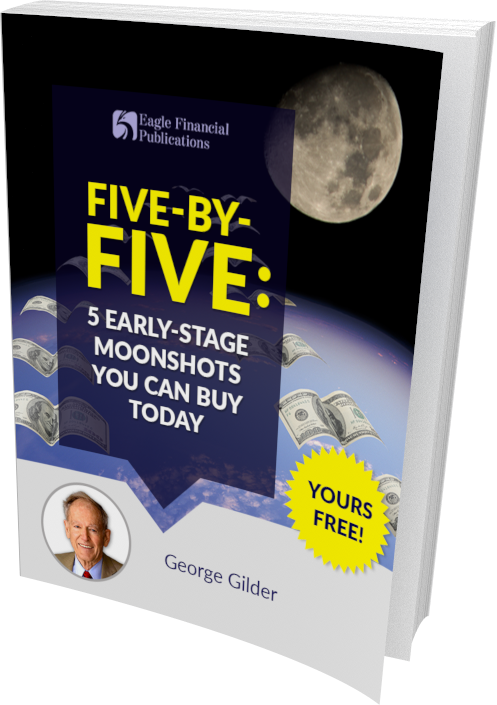
To celebrate the inauguration of Gilder’s Private Reserve and welcome members into Moonshots, your team has just completed a new report.
It’s called Five-by-Five: 5 Early-Stage Moonshots You Can Buy Today, and it contains your top recommendations across every stage of the Moonshots spectrum… five companies for the five different stages.
Can you tell us a bit about them?
Certainly.
Like you said, Moonshots move through five different stages. From the earliest liftoffs … to the mightiest “deep space” ventures well on their way to hitting that $10 billion market cap.
For Stage 1, we’ve selected a company vital to America’s national security interests.
As you likely know, 80% of today’s microchips are manufactured in Taiwan.
Our administration has signed a $280 billion bill called the CHIPS Act, with the goal of creating more chips here at home.
That puts this company in a very unique position.
Because it is the only fully U.S.-owned, pure-play silicon foundry in the entire country.
Foundries have one goal – to manufacture chips in mass quantities.
And now that the U.S. needs more chips, the company is committed to building a $2 billion production facility, conveniently located in the country’s Midwest.
Considering the company is already a trusted supplier to the U.S. defense industry, I think it’s likely it gets a sizeable part of the $280 billion set aside by the CHIPS Act.
It’s a small company now, worth just $500 million. But considering Taiwan’s largest foundry is worth close to $500 billion … and this is the ONLY U.S.-owned foundry … the returns over the coming decade could be massive.
So it’s the only pure-play chip manufacturer in the United States, and we’re moving full steam ahead to make more chips at home. Makes perfect sense why you’d recommend this company. Can you quickly run through the other four?
Yes. I’ll make it short.
Our Stage 2 company is a software business in Israel that you can buy on the Nasdaq. You can think of this company as the glue for Web 3.0, also known as the “Spatial Web,” or the convergence of multiple technologies, including IoT, robotics, AI, 3D printing, 5G, blockchain, cloud computing, and so forth. As the glue, this company works with the world’s largest businesses – such as IBM, Microsoft, Google, Salesforce, and Oracle – to connect to all these different interfaces. Considering over 100 institutional investors own its stock, the returns here could be massive.
Next, our Stage 3 pick is another semiconductor company we recommended doubling down on. Based in South Korea, the company specializes in consumer electronics, developing chips for the OLED technology used in smartphones. Right now, the stock is cheap. It’s about $10 per share, which is where it was in March 2020. Frankly, I don’t expect it will remain priced this low for much longer.
For Stage 4, we’ve chosen the definitive leader in smart car technology. Its AI solutions have been installed in 400 million cars around the globe, and its customers include 60 automakers – including Ford, Tesla, Toyota, and Audi. With an unstoppable 80% market share, sales will go up as cars get smarter and smarter. The stock surged over 500% when we first recommended it but has since backed off. Considering no other company can do what it does, now’s a great time to buy. Sometimes these great stocks go on sale, and we alert our readers when that happens.
Finally, for Stage 5 … we have the emerging leader of conversational AI in the digital workspace. A strategic partner of Microsoft since 2006, they’re integral for all voice communications in Microsoft Teams. With the conversational AI market projected to grow five times this decade – a number we find conservative – and the company forecasting this segment of their business to grow 70% this year alone … the future looks bright for this business.
The full details on all five of these companies are in our new report, Five-by-Five, available exclusively with Moonshots membership, which you get for FREE when you join Gilder’s Private Reserve today.
I’m very excited for our new readers to get their hands on this report.
The goal is to find companies that can go 2-3 times in a couple of years and even 10 times in three to five years.
By focusing on companies with a market cap of $3 billion or less, we can identify those moonshots that have the potential to grow into sizeable mid- and large-cap companies worth $10 billion or more.
But keep in mind – these businesses are more speculative. You should invest no more than 1-5% of your available capital in each one.
But if you subscribe to the Gilder Technology Report … or a similar investment newsletter focused on mid- and large-cap companies … Moonshots is the next step.
With Moonshots and Gilder’s Private Reserve, you have full access to the most important developments in early-stage companies.
Really, the best of both worlds.
By the way, both John and Steve are also formidable guitarists… I don’t know if John will do us the honor of serenading us today, but he is quite good.
That sort of creativity is one of the missing ingredients that so many businesses and business leaders lack.
Just as those two professors at Manchester discovered graphene by ripping Scotch tape off a block of graphite … the greatest discoveries come out of bursts of creativity.
This is why we sing in the shower or get our best ideas on a long walk. It’s why I still run almost five miles a day.
That creativity … that joy and that passion … are at the heart of every entrepreneurial effort.
And they’re exactly what we bring to our research.
Gilder’s Private Reserve is the biggest endeavor I’ve ever launched. I encourage every subscriber who’s been with me for years to sign up, and I hope some of the folks who are just meeting me today do as well.
Well, you heard the man.
This is your chance to team up with George in the most exciting project of his 30-year career.
But I should be clear.
Access to Gilder’s Private Reserve isn’t cheap.
After all, this is your chance at opportunities once reserved for billionaire venture capitalists.
And considering the nature of startups, there’s simply not room for everyone.
These aren’t publicly traded stocks.
After all, George has received fees as high as $100,000 for a single speech.
And this is some of his most exclusive research to date.
Remember … startups don’t trade like stocks in your brokerage account. There’s less room.
So, frankly, $100,000 for this level of access would be reasonable.
But don’t worry… We’re not going to ask you to pay that.
To open this opportunity up to as many folks as possible, George and I have set the price for Gilder’s Private Reserve at just $5,995.
You can join at that price anytime after today.
However, because you joined us for our grand opening celebration, our public debut of Gilder’s Private Reserve…
George and I have also agreed to give you a special opportunity to join as a Founding Member for a very special price.
Not $10,000…
Or even $5,000…
If you claim one of the first 100 Founding Memberships, you can join today for a full 33% off the regular price for Gilder’s Private Reserve.
Just $4,000.
But it’s first come, first served.
Again, we can only take 100 members on at this reduced price.
So I hope you claim your spot while you can.
A button should be appearing on your screen now. Go ahead and click it to open a secure order form in a separate window while George and I share a few final words.
George, any last words for our viewers?
Yes. As mentioned, this is not your typical research service.
The goal is to turn our readers on to the biggest developments in private markets. We’ll aim to recommend a minimum of four opportunities per year, in addition to monthly issues on the latest advances.
Like I said before, Jim’s company is currently raising money. However, they’re doing it through conventional venture capital, not through Jonathan’s crowdfunding opportunity or Reg D.
The good news is, both parties seem receptive to teaming up. I’ve made the proper introductions already. Just no hard news yet.
Again, we’ll often write to you about these companies for months before we actually pull the trigger.
There is no rush. It’s not like Jim’s company will wind up on the New York Stock Exchange tomorrow.
Our goal is to recommend the four best private business opportunities to you over the next year. But we’ll be in communication every month, telling you about the best companies we see.
And again, by pairing their subscription with a free year of Moonshots, members can invest in early-stage companies that are already publicly listed.
These companies are small. The ones I told you about are worth between $500 million and $1 billion. That means we only need a few of them to reach that $10 billion mark to see a sizeable gain on the total portfolio.
I just want to restate, with the team you guys have in place, this is going to be the greatest early-stage investment advisory on the planet.
If you haven’t already, go ahead and click the button on your screen to head to our secure order page.
There, you can review the full details on Gilder’s Private Reserve and select the option that best fits your needs.
George, any last words before we sign off?
Subscribe! This is the most exciting project I’ve started in 30 years.
Well, thank you, George, and thank you, John, and thank you all for reading. I’m Roger Michalski, and on behalf of George Gilder and Eagle Financial Publications, I look forward to welcoming you to Gilder’s Private Reserve. Enjoy.
